
Framework First
Framework First Academy teaches analysts and operators the judgment layer most courses skip: when to use each framework. Thirty courses organized across four stages: Diagnose, Automate, Manage, Deliver. The studio designed the brand, the site and the learning experience end to end.
One of two products designed end to end for the same client — the other is DawnPulse.
- Role
- Lead Product & UX Designer
- Year
- 2025 — Ongoing
- Scope
- Brand Identity, UX Architecture, Website Design, Design System
- Live
- Visit site ↗
Context
Learn when to use each framework, not just how.
Deliverables: Brand system, Information architecture, Marketing site, Course UX, Component library.
Problem
Online learning is a sea of interchangeable course grids. Framework First’s real differentiator, sequencing judgment rather than just content, is abstract and hard to communicate in a hero section. The design had to make “a problem enters, delivered value exits” tangible: a system you can see, not a claim you have to believe.
Process
Reviewed competing academies and course platforms. The gap was consistent: content everywhere, judgment nowhere. Validated the four-stage framing with the founding team.
Mapped the learner journey from “problem lands on desk” to “delivered value” and identified the two core personas, the student and the senior operator, each needing a different entry point.
Wireframed the stage-based navigation, course detail patterns and the decision-map lead magnet. Explored typographic systems that carry both editorial warmth and technical precision.
Prototype-tested the catalog with target users. Could they find the right stage for a real problem in under 30 seconds? Iterated on stage labeling and course cards until they could.
Shipped the brand, marketing site and a component library covering course cards, stage navigation and curriculum templates, ready for the team to scale to new courses.
Key decisions
The system is the design
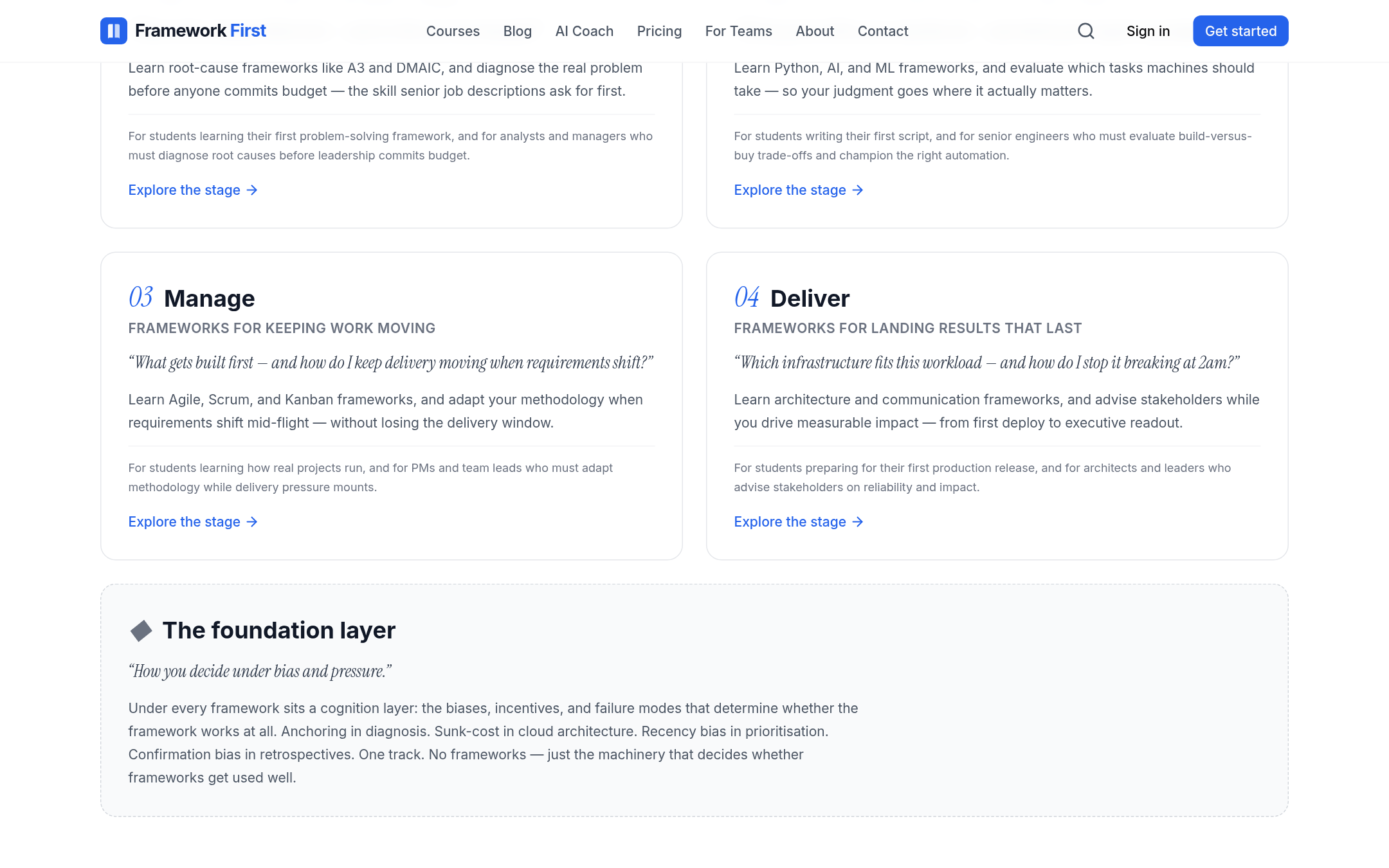
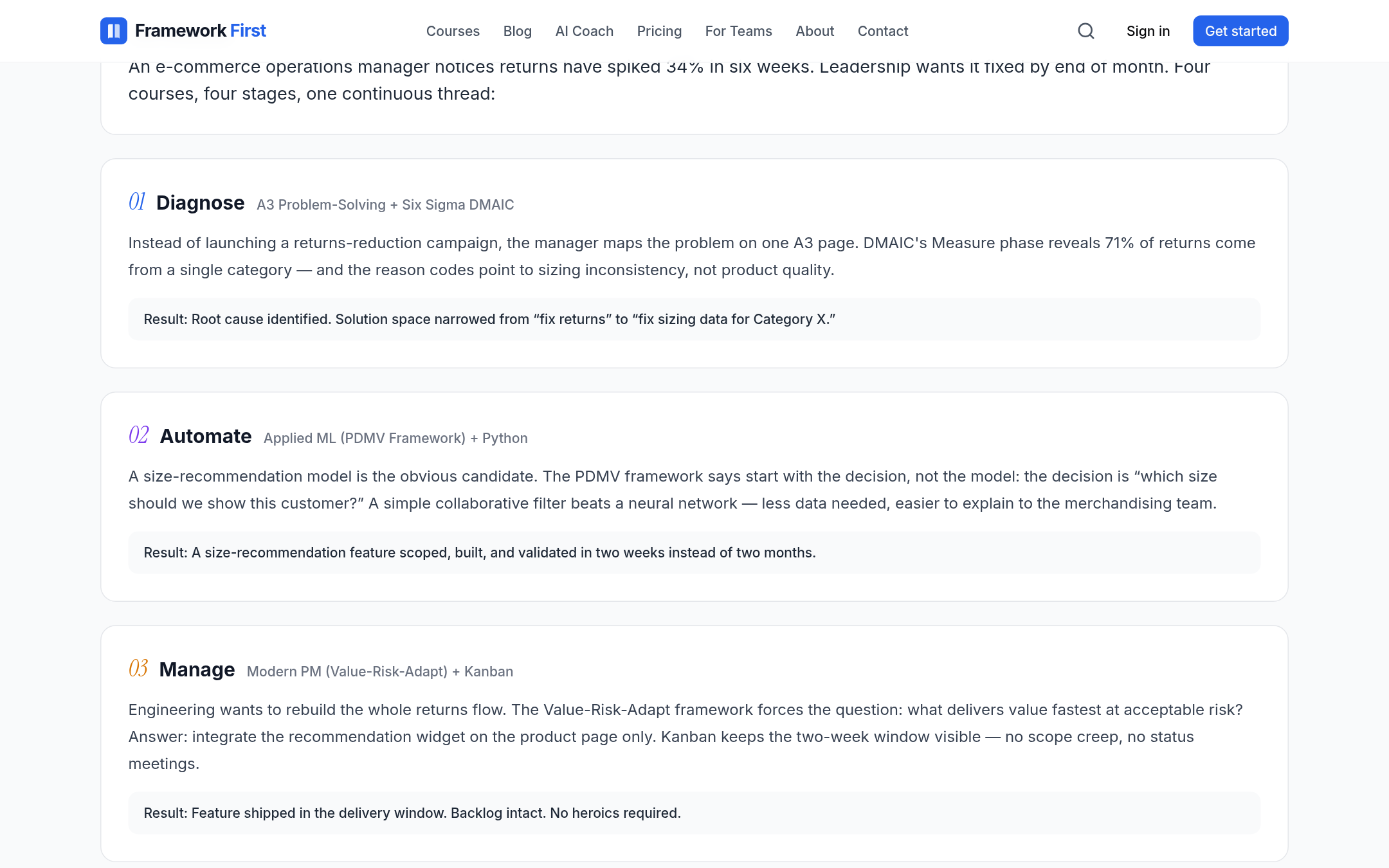
The four-stage model became the organizing principle of the entire IA: homepage, course catalog and curriculum pages all mirror Diagnose → Automate → Manage → Deliver.
Editorial authority
A blueprint-inspired visual language (precision grid, serif italics, engineered blue) positions the academy as a practitioner’s reference, not another course marketplace.
Dual-audience UX
Every stage speaks to students and senior operators simultaneously. Content blocks pair “learning your first framework” with “the skill senior job descriptions ask for first.”
Product
What was delivered
30
Courses in a single coherent system
04
Stages mirroring real work
02
Audiences, one experience
These are delivery facts — what the design contains, not business results. The products are live and in use; measurable outcomes will be reported here when the client shares them. What was validated with real users during the process is documented above.
Working on something similar?
Tell me what you're building and where it's stuck. You'll get an honest read on whether I can help — and what working together would look like.